


What Barrio Yungay Doesn’t Show You From the Outside
We Lived in Barrio Yungay for three weeks. Here’s What We Found.
Barrio Yungay is one of Santiago’s oldest neighborhoods, originally home to some of the city’s wealthier families. As Santiago expanded and wealth moved east, those families gradually left, and Yungay became much more middle- and working-class. María, my masseuse who we met later in the neighborhood, summed it up much better: “The rich people left, regular people moved in, and they made it theirs.”
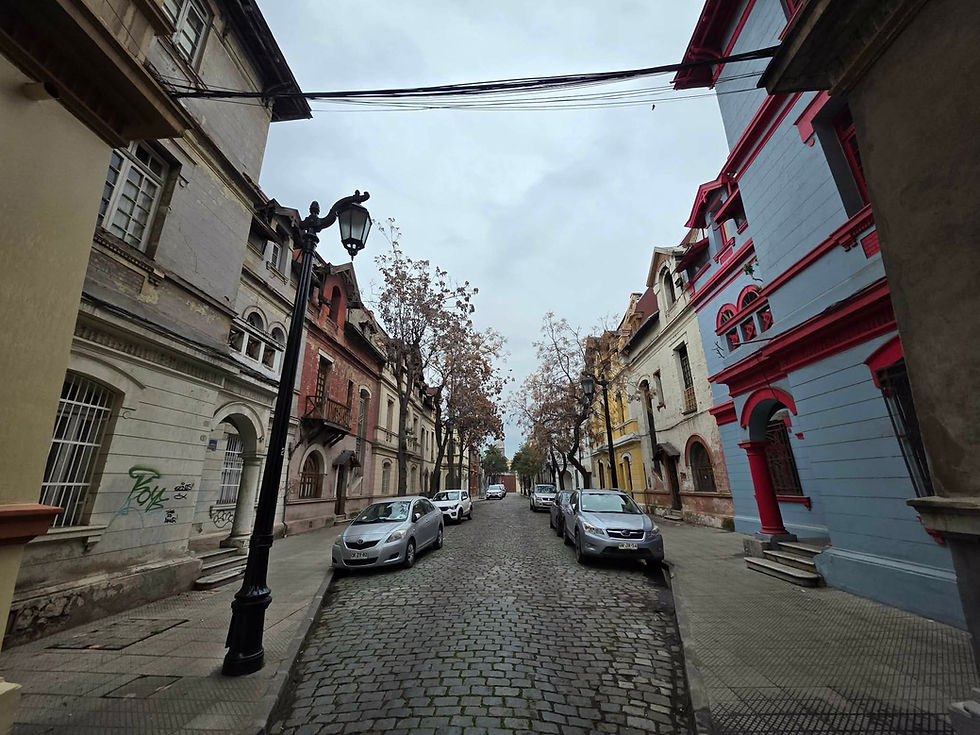
Photos in our Airbnb lobby showed our building before and after its renovation: once worn and covered in graffiti, it had been restored, with a modern apartment addition rising above the original structure.


One of the first places that caught our attention was Ocean Pacific’s. Its not technically in Barrio Yungay, but in Barrio Brasil, just to the east. We passed an open, garage-like space filled with aquatic stuff—diving equipment, nautical objects, strange sea creatures, things hanging everywhere. Restaurant? Museum? Storage space for someone with a serious maritime obsession? We had no idea.

A week or so later, curiosity got the better of us. We looked it up.
It was a restaurant, so we went back.

Ocean Pacific’s started in 1989 with just a handful of tables. Owner Marcos Rulli gradually filled it with diving helmets, ship equipment, boats, fossils and maritime curiosities, with customers adding donations of their own. After a 2019 fire destroyed much of the collection, they built it all over again with renewed maniacal interest. Today, the collection is officially recognized as a maritime museum.

The bar alone was packed with diving helmets, ship models, propellers, sea creatures and nautical equipment. Every so often, a robot waiter rolled through carrying somebody’s food.


Our waiter, Benjamin, became fascinated by our travels, and we talked quite a bit over oysters, vegetables and fish—which I was too interested in eating to photograph until I’d already eaten half of it. Benjamin eventually offered to show us around.


Upstairs, the maritime theme continued in a more luxurious direction, with private dining rooms filled with dark wood, old maps, model ships and maritime antiques. It had all the imagination and playfulness of downstairs, but with an elegant, grown-up flair.

Back at the Airbnb, the pillow and my neck did not get along, and within a few days my neck was killing me. Looking for a massage led to us knocking on several wrong doors and awkwardly trying to explain in Spanish and English why two Americans were standing there asking about a massage.
Eventually we found María. I made an appointment for after our ski trip to Valle Nevado. She literally saved the trip.
That same day, we tackled the other half of the problem: buying a pillow. Even a mundane errand becomes more interesting when you have to find an actual pillow store, decipher pillow terminology in Spanish and compare prices. On the way home with my new pillow, we ran into María.

You can find María here
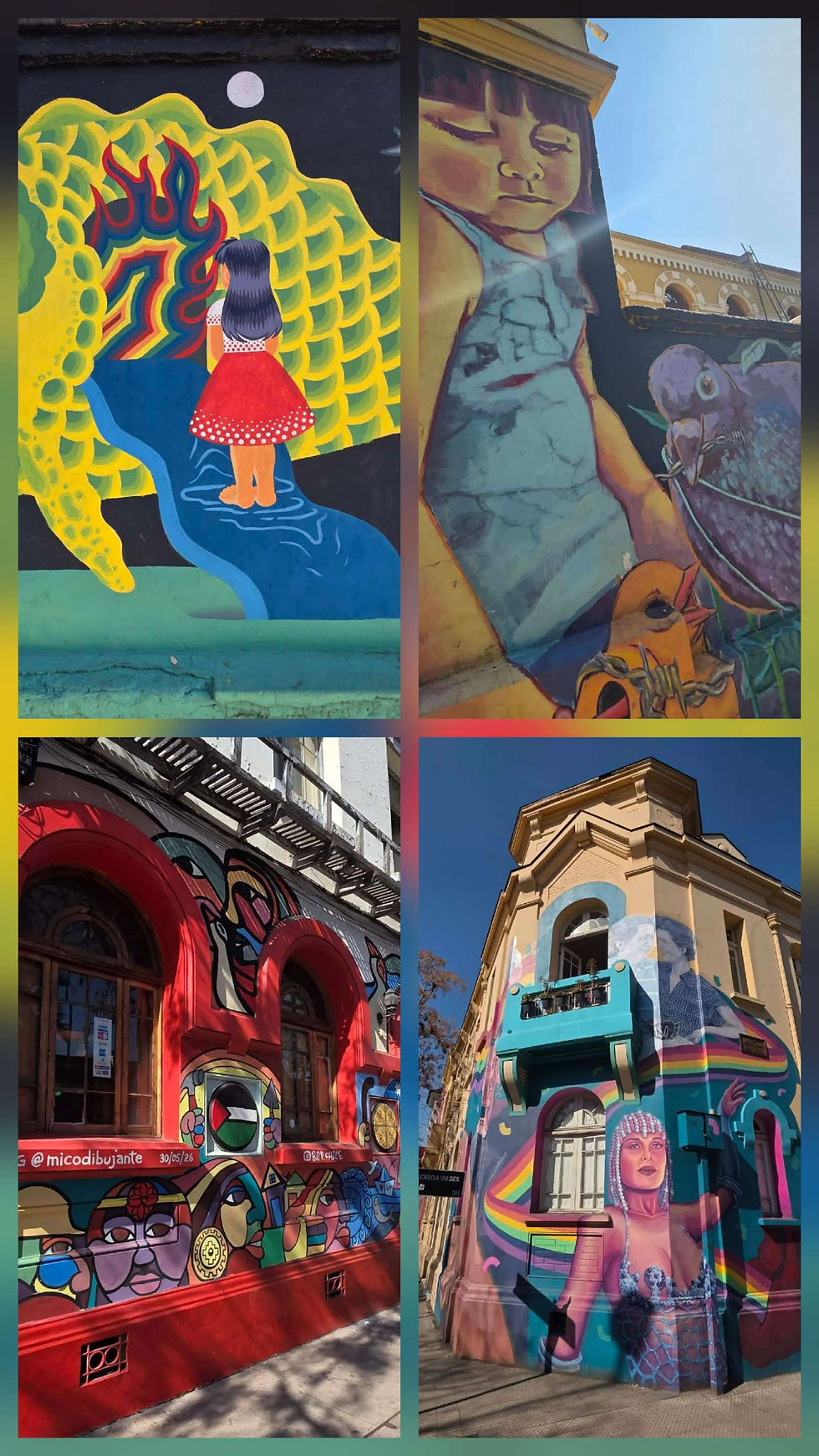
María also offered to show us around Yungay. She walked us through side streets and past some of the street art we had already started noticing ourselves. Murals cover entire walls and buildings here, from enormous portraits and fantastical creatures to works reflecting Chilean history, politics and identity.
And the inventiveness wasn't limited to the murals—one house even had an elevated walkway running from an upstairs window into a tree for the cats.

Then, María led us through an unassuming blue doorway into a place called Zarita.

There was nothing outside to prepare me for what was inside, and my mouth dropped.

The casona—a large traditional house built around a courtyard—is filled with restored and recycled objects, transformed into something warm and striking. Antique mirrors, chandeliers and stained glass mix with lush plants, vintage ads, musical instruments and furniture. Lamps have been made from instruments, an iron balcony has become the bar, and the rooms open onto a courtyard filled with plants and colored glass.


Zarita is an Arequipeña restaurant, specializing in the food of Arequipa, Peru. Santiago’s tourism site calls it a “cult restaurant” of Barrio Yungay, known for its home-style Arequipa cooking.
Yungay doesn’t always show you what it has from the outside.
We came back later for a late lunch, and the food was every bit as memorable as the place itself.


María also told us about the Museo de la Educación Gabriela Mistral, so later that day we went on our own. The small museum, in a former teacher-training school built around a courtyard, traces the history of education in Chile. Mistral was a teacher and advocate for poor and rural children before winning the Nobel Prize in Literature.


Another small neighborhood museum, the Museo del Sonido, follows sound from the science of vibration through the development of recorded music, with phonographs, radios, instruments and interactive exhibits.


Chris was particularly taken with Mingus Coffee, the café in its courtyard, and its owner, Manuel—despite the fact that I had tea and he had hot chocolate.


Also right in the neighborhood is the Museo de la Memoria y los Derechos Humanos—the Museum of Memory and Human Rights—which feels fitting in Yungay. It documents the 1973 military coup, the Pinochet dictatorship and the thousands of Chileans who were killed, disappeared, imprisoned, tortured or forced into exile. We took an English-language guided tour, which was especially helpful in understanding what we were seeing.
Photographs, television broadcasts, government documents, survivor testimony and personal objects tell the story. One of the most powerful parts is an enormous wall of photographs of people who were killed or disappeared.
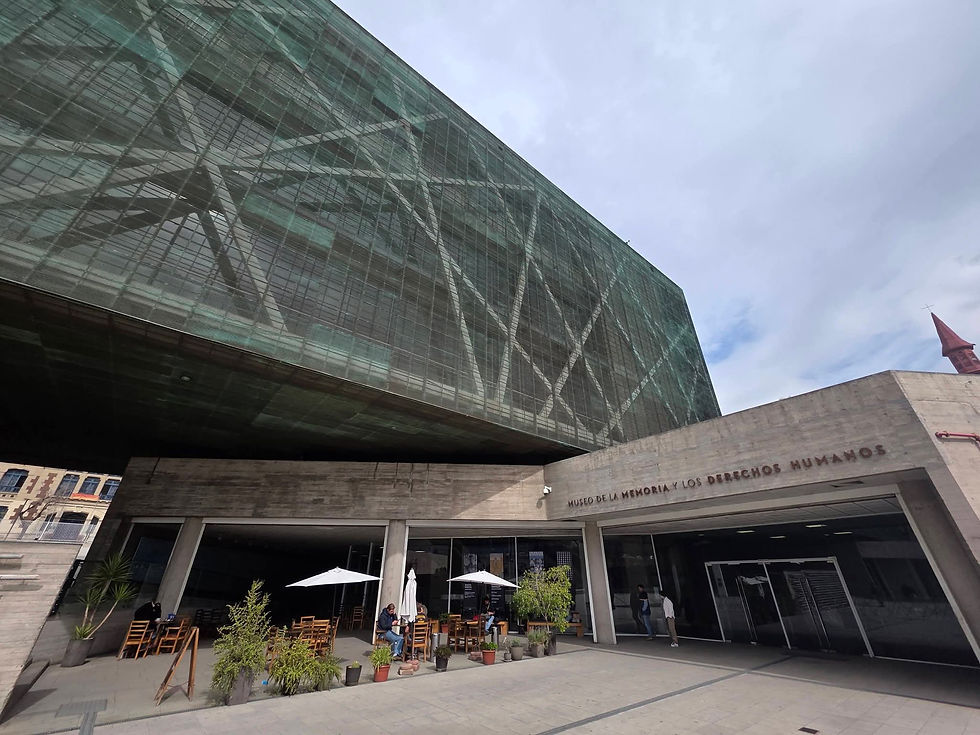

Our guide also told us that future funding for the museum is uncertain. It’s fitting that “Memory” is in the museum’s name, because so much of the museum is about memory itself—how a country records what happened, how the people who disappeared are remembered, and how that history is carried forward, making sure this history isn’t forgotten.
(Support this museum and take a Viator tour)
And somehow, after a month in Yungay, there was still more happening around us. On our last weekend, still sniffling through the tail end of a cold, we went out in search of soup and realized we were missing an entire neighborhood day -Colors of Yungay- streets filled with people, music, vendors and even a train!


And then there was Plaza Yungay, the neighborhood’s central park, which was under renovation for our entire stay. We never even got to see what the neighborhood is like with its main plaza actually open.
Another reason to go back.

Enjoyed discovering Yungay with us? Buy us a coffee and we’ll keep seeing what’s behind the next door. ☕


Comments