

We Went to Valparaíso to Explore Aimlessly. Then We Met Alex.
Updated: Sep 3

We went to Valparaíso with very little planned. The idea was basically to get there, wander around and see what we found.
First, we had to find the bus.
At the terminal, we went to where we thought our FlixBus should be.
It wasn't there.
We wandered around looking for it, assuming we were lost again, until someone kindly directed us to the ticket office.
Turns out, the bus had been canceled.
Eventually, we found another one, and an hour and a half later, we were in Valparaíso.

Valparaíso is a mix of colorful houses, steep streets, painted stairways, balconies and verandas spread across a series of hills. It was once one of South America's most important ports, a major stop for ships rounding Cape Horn. When the Panama Canal opened in 1914, much of that traffic disappeared. Today, its historic quarter is a UNESCO World Heritage Site.
We were there in the off-season, and it was a Monday, when many places in Valparaíso are closed. The city was quiet.
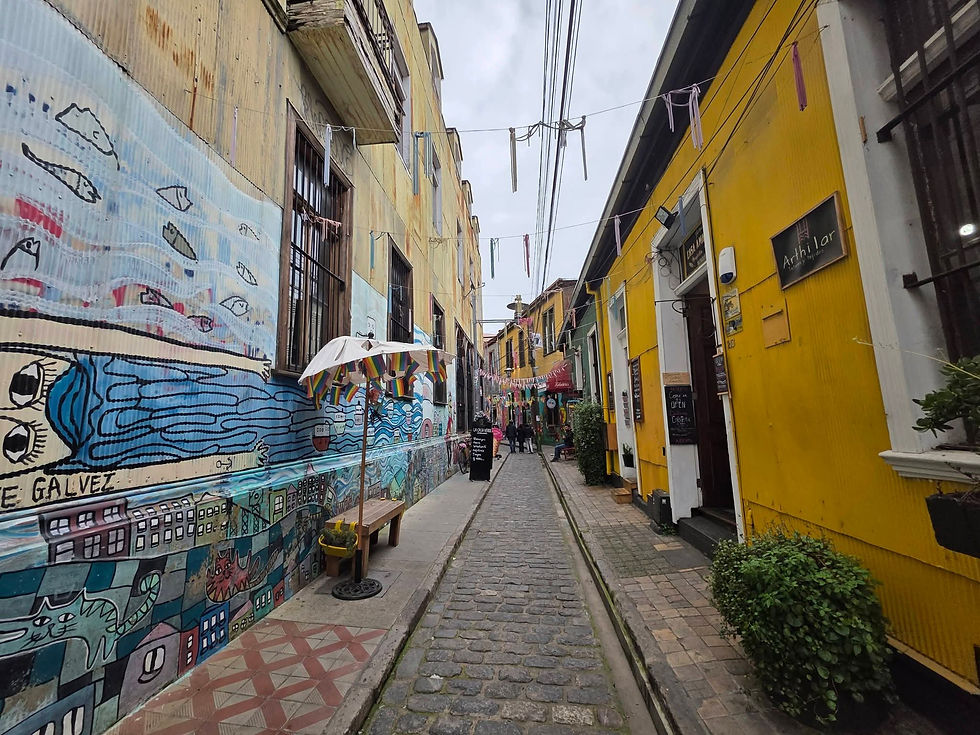
We actually liked it that way. Without crowds filling the streets and stairways, we could really see the structure of the city—the houses spread across the hills, the narrow passages between them, the painted staircases and the harbor below.

Historic funiculars—called ascensores—still carry people between the lower city and the neighborhoods above.
We knew where one was on the map, but weren't sure how to get there, so we got on a local bus and asked the driver if he went that way.
No, he told us.
A woman on the bus promptly intervened. Actually, yes, he did.
When we reached the stop, she got off with us and, without saying a word, indicated that we should follow her. So we did. She led us in the right direction, and after a few more blocks, we found the funicular.

The buses themselves have a character to them—steadfastly independent, still privately operated and still taking cash despite years of efforts to modernize and integrate the system. Somehow, that seems to fit Valparaíso.

We finally made it to the funicular.

And I needed a bathroom.
Once again, needing a bathroom was about to change our day.
This is getting embarrassing.
I was trying to ask whether there was a bathroom at the top when a man nearby heard us and translated for us. There wasn't one, he told us, but we could use the bathroom in his office nearby.
He was a tour guide, his name was Alex, and he could show us around.
That sounded like a pretty good idea. Valparaíso, with its stairways, back streets and neighborhoods spread across the hills, isn't the easiest city to simply wander through and know what you're looking at.

So after the bathroom, we set off with Alex.
It quickly became clear that Alex knew everybody. He'd point to someone's wall art or home and say, “Oh, I know them.”

And “everybody,” apparently, included the dogs.

Alex had figured out the quickest way to a Valparaíso dog's heart: he fed them from time to time. As we walked, dogs would appear and happily fall in behind him. Before long, it looked like Alex was leading a completely unofficial canine tour of Valparaíso, with us tagging along.

The dogs seemed to consider the streets theirs, too. They barked indignantly at every car that came through, and the drivers slowed down and carefully worked their way around them. Nobody seemed particularly surprised by any of this.
And the dogs were committed to the tour. Every time we went inside somewhere, they simply waited patiently outside for Alex to come back out. Then off we'd all go again.

One of those stops was Rojo Galería, where, naturally, Alex knew the people. The gallery in Cerro Alegre focuses on Chilean contemporary painting and street art, with work by both established and emerging Chilean artists.

It was especially interesting after walking through Valparaíso because the art inside looked like an extension of what we'd been seeing outside: colorful houses, hills, ascensores and the city itself, interpreted in completely different ways.
Later, Alex led us up a narrow staircase and out onto a corner street, where a small, older chilean woman he knew sold homemade alfajores that lives in the Luigi Bavestrello passage.

Meanwhile, Alex was showing us a Valparaíso we probably wouldn't have found by simply following a map. Narrow staircases disappeared between buildings. Streets went off at odd angles. Murals covered walls and stairways. Houses spread across the hills in every direction. Artists sold their work along the overlooks. Then we'd turn a corner and suddenly there was the harbor below us.

Somewhere along the way, we learned that Alex was originally from Cuba. That naturally led to a lot of conversation about Cuba—and even the possibility that if we ever make it there, maybe Alex could show us around there too.
Eventually, Alex brought us to a restaurant overlooking the harbor.
We were the only people there.
Like much of Valparaíso that Monday, it was quiet. We had the whole window-lined room and the enormous view over the city and harbor to ourselves. It felt almost like having our own private restaurant.

And then there was the food. The seafood was spectacular—and it absolutely lived up to the view.


Somewhere along the way, the day expanded again. Alex suggested Viña del Mar. We hadn't planned on going there at all, but it was nearby, we still had time, and it sounded like a good idea.
And apparently Alex was driving.
So off we went to Viña del Mar.
Although it's only a short distance from Valparaíso, Viña del Mar feels completely different—flatter, more polished, a lively coastal city with the feel of a beach town.
We were hoping to make it to the coast for sunset.
Then the road was closed.
By the time we got around it, the sun was disappearing fast, and suddenly we were racing to catch a sunset we hadn't even known that morning we'd be trying to see.
We made it.
Barely.
We climbed out onto the rocks, joining dozens of other people who had come for exactly the same reason. Everyone spread out along the rocks facing the Pacific as the sun dropped toward the horizon.

And then we watched it disappear.

It wasn't just a sunset picture. It was an experience—dozens of strangers gathered on the rocks together to watch the end of the day, and one we had come very close to missing.

Afterward, Alex drove us to the bus station for the ride back to Santiago.
We'd gone to Valparaíso intending to explore aimlessly.
Fortunately, I needed a bathroom. And then we met Alex.
If you'd like to meet Alex without relying on a bathroom emergency, you can find his Valparaíso tours on Viator.


Comments