


The Architecture Student Whose Name We Never Got
Updated: Aug 23
The day started at Palacio Cousiño, the lavish 19th-century mansion of one of Chile’s wealthiest families. We hadn’t known they offered tours, but the next one was an hour away, so someone suggested we spend the time at the nearby Military Museum.
So we did.

An hour wasn’t nearly enough. We left knowing we’d have to come back.
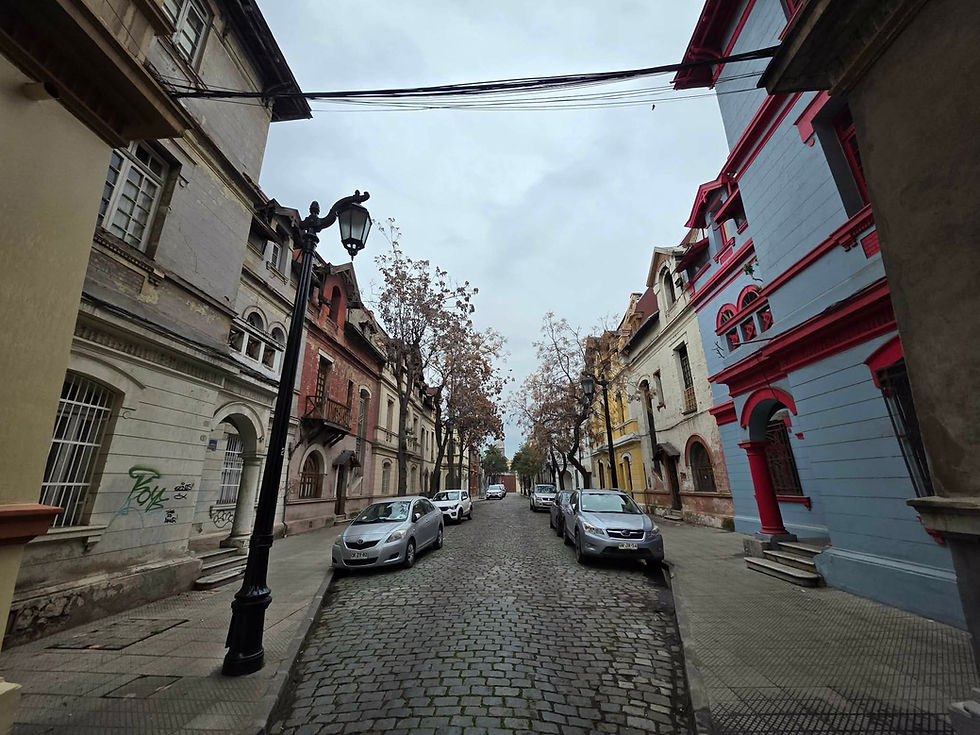
At one point in our adventures for the day we passed an open doorway that looked vaguely like a lobby. We stopped and peeked inside, trying to look casually curious rather than like two tourists peering into someone’s private domain.
A young man going inside asked if we needed help.
Chris wanted to know what the building was. I needed to know if it had a bathroom—and whether we might be invited to use it.
Happily, both questions had excellent answers.
It was a residence for architecture students, and he was one of them. And yes, there was a bathroom.
After that, we stayed and talked. He asked where we were from and what we’d seen, then started recommending places we should go. Among them were the Museum of Pre-Columbian Art and the Bahá’í Temple.
Somehow, despite Chris being Chris and usually learning the name and life story of everyone we talk to, we never got this guy’s name.
But, back to Palacio Cousiño... we stepped inside to something we’d begun to notice in Santiago: the outside of a building often gives you very little idea of what you’re about to find inside.

The Cousiño fortune came largely from mining, especially coal, and the family was also involved in Chile’s copper industry. The tour was entirely in Spanish, so we followed along with Google Translate. Our guide explained where the women gathered, where the men gathered, and which spaces they shared.

And even with that gender divide, Isidora Goyenechea took over the family business after her husband died in 1873 and went on to manage its vast mining and industrial enterprises herself.


The palace was beautiful and excessive, but we were also beginning to learn Chile’s history.

The next day, it poured. We took an Uber back to the Military Museum.
It was closed.

As we stood helpless in the rain, we remembered our architecture student and his recommendation of the Pre-Columbian Museum. As our Uber pulled away, we were already calling another one.
A few minutes later, we were dry inside the Pre-Columbian Museum.
The first place to start is Chile Before Chile, deep in the basement. It’s dark—really dark—and focuses on the Indigenous cultures of what is now Chile. Upstairs, the museum broadens out to cultures across the pre-Columbian Americas.


I mostly walked around taking pictures of whatever drew me to them—a strange face, an intricate pattern, an unusual shape. I wasn’t necessarily trying to document the museum; I was photographing what caught my attention.


There was also an exhibit about AI, presented through short visuals on screens in a darkened room. What interested me was the connection between past and present. So much of Chile’s history is tied to what lies beneath its ground, especially copper and other minerals. Now, AI and new technologies are bringing renewed international attention to those resources—and to what Chile’s mineral wealth might mean for the future.
The next day was gorgeous. Our nameless architecture student had been right about the museum, so we decided to try his other recommendation: the Bahá’í Temple.

Getting there took about an hour and a half on public transportation, carrying us out of central Santiago through quieter, less polished and urban neighborhoods. Then we had another mile to walk—all uphill. There were views along the way, including a rock where we stopped for a picture alongside a group of young people doing the same thing.

The climb wasn’t terrible, although that didn’t stop me from complaining. At the visitor center, my first priority was water.
The Bahá’í faith sees the world’s major religions as part of the same continuing spiritual story, with an emphasis on the unity of humanity—an idea that resonated with me. An Australian volunteer explained the faith and the temple before we continued up, where the views were spectacular.

There’s no talking inside. We sat quietly for a while, and between the silence, the light and those views just outside, there wasn’t much reason to talk anyway.

After walking the mile back downhill, I desperately needed a bathroom.
So we got on a bus.
We had no destination. We were literally taking a bus anywhere in hopes of finding a bathroom. About five minutes later, we spotted a Starbucks.
“STOP! LOOK!"
We started telling the driver to stop, followed by lots of “muchas gracias, muchas gracias!” as we scrambled off.
The Starbucks was closed. But there were public bathrooms nearby—and a sushi place.

Once again, my need for a bathroom had determined where we went next.
The following day, amongst other adventures, we finally made it back to the Military Museum.
What surprised me most was how artistic it was. “Military” doesn’t necessarily make me think of creativity, but the paintings and elaborate battle scenes were as interesting visually as they were historically.

And Chile has had a rough history to depict: the War of Independence from Spain, the War of the Pacific against Peru and Bolivia, and the Civil War of 1891. To me, that civil war functions as a prequel to the political divisions that would eventually lead to Allende, the 1973 coup and Pinochet.

It had taken us three tries, but we finally finished the Military Museum. Not bad for a chain of events that started with an architecture student whose name we never got—and my need for a bathroom.

Shop our photography on Picfair
But where’s the coffee? ☕
Sometimes it’s from a French press or a coffee machine. Sometimes it’s even instant . Sometimes it’s a paper cup, a neighborhood café, or something considerably fancier. We just need to find it somewhere.
Keep the trips coming! Buy us the next cup!


Comments